

If you’re searching for practical, realistic advice on decluttering for families, you’re likely feeling overwhelmed by toys, papers, clothes, and the constant flow of stuff that comes with family life. This article is designed to help you simplify your home without adding more stress to your already full schedule.
We’ll walk through step-by-step strategies that work for busy parents, age-appropriate ways to involve your kids, and simple routines that prevent clutter from building back up. Instead of picture-perfect ideals, you’ll find family-friendly systems that fit real homes and real routines.
Our guidance is grounded in proven organization principles, child development insights, and feedback from experienced parents who have successfully transformed chaotic spaces into calm, functional environments. By the end, you’ll have a clear, manageable plan to reduce clutter, create smoother daily rhythms, and build habits that keep your home feeling lighter and more peaceful long term.
Family life is beautiful, but it often leaves a trail of toys, papers, and half-finished projects in every room. Over time, that visual noise raises stress: UCLA’s Center on Everyday Lives of Families found cluttered homes correlate with higher cortisol levels in parents. So, while the chaos feels normal, it isn’t harmless. This guide offers a simple, tested system for decluttering for families, moving beyond frantic weekend tidying toward sustainable habits. Because when everything has a home, mornings run smoother, arguments drop, and you reclaim time for what matters most—each other. Think of it as Marie Kondo meets real life.
The ‘Why’ Before the ‘How’: Setting the Stage for Success
Physical clutter is not just visual noise; it’s cognitive overload. Researchers have linked messy environments to higher cortisol levels, the stress hormone, which means that piles of laundry can drain your patience. In other words, the more you see, the more your brain tracks. And when your brain is tracking, it’s not fully present (yes, even during bedtime stories).
So, before color-coding bins, define your family’s “Enough.” Organized might mean clear counters by 8 p.m., not a minimalist showroom. Harmonious could simply be mornings without frantic shoe hunts. Admittedly, some argue that striving for Instagram-ready spaces motivates habits. Perhaps. Yet speculation: as family life grows busier, future trends will favor realistic systems over perfection.
After all, the goal is function, not flawlessness. A home supports homework, meals, and rest with friction. Pro tip: start with decluttering for families at home.
The 3-Step Method: Declutter, Designate, and Discipline
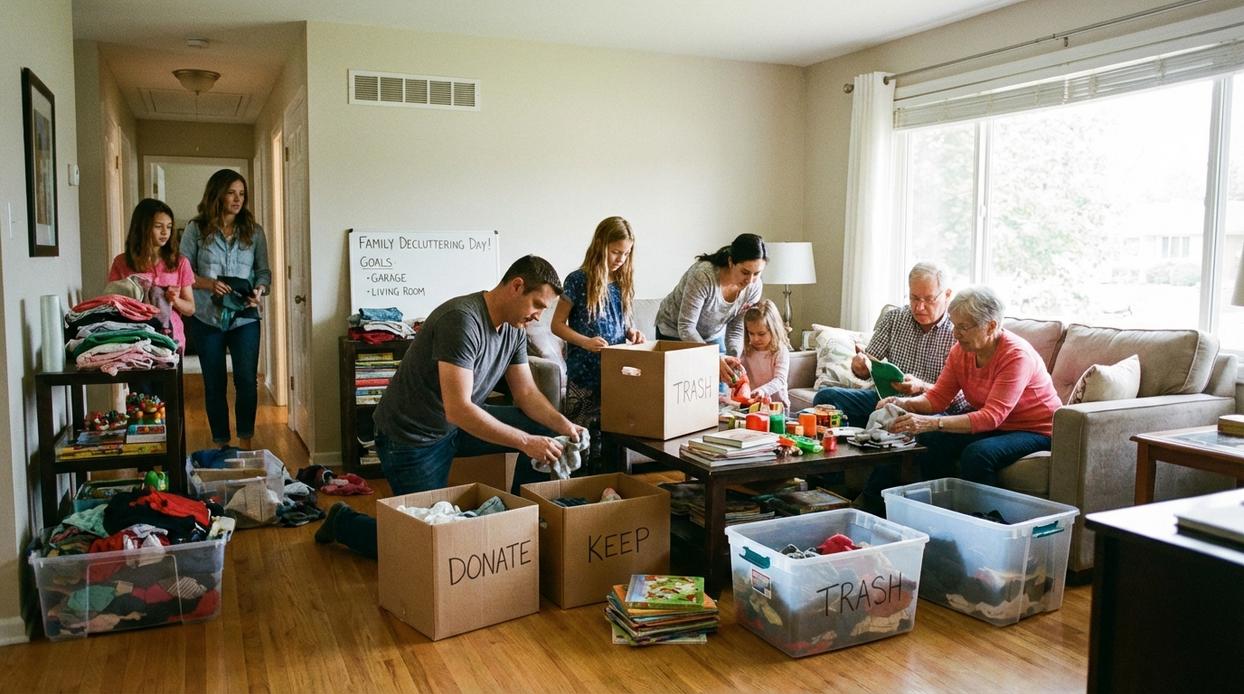
When people hear “get organized,” it often sounds overwhelming. So let’s simplify it. This 3-step method breaks decluttering for families into three clear, repeatable actions: remove what you don’t need, decide where things belong, and build tiny habits to keep it that way.
Step 1: Declutter with Purpose (The Purge)
First, decluttering isn’t about throwing everything away. It’s about deciding what still serves your family. A helpful rule is the “one-in, one-out” rule—for every new item that enters your home, one item leaves. This prevents silent buildup (because clutter rarely arrives all at once).
Next, create a Donation Station—a designated basket or bin for items ready to go. When it’s full, donate immediately.
If decision-making feels emotional, try this: ask, “Would I buy this again today?” If the answer is no, that’s your clarity. Pro tip: set a 15-minute timer to avoid overthinking.
Step 2: Designate a Home (The Placement)
Now that you’ve reduced excess, every remaining item needs a logical “home.” A home simply means a consistent storage spot.
This is where Zoning comes in. Zoning means grouping similar items where they’re actually used. For example, create a homework caddy with pencils and chargers in the study area. Or set up a morning routine station near the door with shoes and backpacks. When items live near their point of use, cleanup becomes automatic.
Step 3: Discipline the System (The Habit)
Finally, systems fail without habits. Enter the 10-Minute Tidy—a short, family-wide reset each evening. Set a timer, play music (yes, make it feel like a montage scene), and return items to their homes.
Small, daily resets prevent weekend chaos. And over time, order stops feeling like a project—and starts feeling normal.
Conquering the Chaos Zones: A Room-by-Room Action Plan
Let’s start where the chaos walks in—literally.
1. The Entryway/Mudroom
“The second I open the door, it’s like backpacks explode,” one mom told me. Sound familiar? The entryway becomes the daily dump for shoes, coats, and mail. However, this space can work for you instead of against you.
Install wall hooks at kid height (yes, low enough that they can’t say, “I can’t reach”). Add labeled cubbies for each family member and a small bench for shoe removal. Most importantly, create a designated mail bin—one container, no exceptions. According to the National Association of Productivity & Organizing Professionals, clear systems reduce daily stress triggers in the home.
Pro tip: Limit each person to one pair of grab-and-go shoes in the entry. The rest live elsewhere.
2. The Living Room/Play Area
Next up: the toy takeover.
“I just cleaned this!” you say. “But I need all of them!” your child insists. Instead of constant battles, try a toy rotation system. This means keeping only a portion of toys accessible while storing the rest and swapping them every few weeks. Researchers at the University of Toledo found that fewer toys actually encourage deeper, more creative play (Dauch et al., 2018).
Use attractive, accessible bins and baskets your kids can manage themselves. If they can’t lift it, they won’t use it. This approach is especially helpful when decluttering for families who feel overwhelmed by volume.
3. The Kitchen Counter
Finally, the clutter magnet: the counter.
“Why is there a soccer form next to the toaster?” someone inevitably asks. To reclaim this prime real estate, try:
- Vertical storage (wall-mounted racks or magnetic strips)
- A family command center for papers
- A five-minute nightly surface sweep
For more practical ideas, check out 15 time saving hacks for busy moms.
After all, clear counters make calmer mornings (and fewer frantic lunchbox hunts).
Getting kids involved in organizing isn’t just cute; it’s practical. When you make tidying a game, complete with a five-minute timer or a favorite playlist, you turn chores into friendly competition (think “beat the clock” energy). Give them ownership by letting toys “live” in labeled bins with pictures—an evidence-based strategy that supports early literacy skills (NAEYC). Model consistency by putting your own items away; kids mirror repeated behavior, according to social learning theory. For decluttering for families, try:
- color-coded baskets for quick sorting,
- low, open shelves sized for small hands.
Pro tip: rotate toys monthly to maintain excitement and order.
Your New Normal Starts Now
First, take a moment to celebrate. You didn’t just tidy up—you chose a more functional, peaceful home. That matters. The daily stress of clutter—the frantic searches, the visual noise, the low-grade overwhelm—loses its grip when you follow a clear system. That’s the power of Declutter, Designate, Discipline. It turns good intentions into simple, repeatable habits everyone can follow.
So what’s next? Start small. One drawer. One countertop. One visible win. In decluttering for families, momentum builds confidence—and confidence builds consistency. Then repeat tomorrow.
Create a Calmer, Happier Home Starting Today
You came here looking for realistic ways to bring more order and peace into your home—and now you have a clear path forward. By focusing on decluttering for families, you’re not just clearing space. You’re reducing daily stress, saving time, and creating a calmer environment where everyone can thrive.
The chaos, the constant cleanup, the feeling of never being “caught up”—that’s exhausting. But small, consistent steps make a lasting difference. When you involve your kids, simplify your systems, and focus on what truly serves your family, clutter stops controlling your home.
Now it’s time to take action. Start with one drawer, one shelf, one room today. Follow a simple routine, stay consistent, and build momentum.
Thousands of moms rely on proven, practical routines to simplify their homes and reclaim their time. If you’re ready to feel less overwhelmed and more in control, start your family’s decluttering plan today and experience the difference for yourself.
 Parenting Content Director
Nicholas Beltaisers is the kind of writer who genuinely cannot publish something without checking it twice. Maybe three times. They came to borode motherhood journeys through years of hands-on work rather than theory, which means the things they writes about — Borode Motherhood Journeys, among other areas — are things they has actually tested, questioned, and revised opinions on more than once.
That shows in the work. Nicholas's pieces tend to go a level deeper than most. Not in a way that becomes unreadable, but in a way that makes you realize you'd been missing something important. They has a habit of finding the detail that everybody else glosses over and making it the center of the story — which sounds simple, but takes a rare combination of curiosity and patience to pull off consistently. The writing never feels rushed. It feels like someone who sat with the subject long enough to actually understand it.
Outside of specific topics, what Nicholas cares about most is whether the reader walks away with something useful. Not impressed. Not entertained. Useful. That's a harder bar to clear than it sounds, and they clears it more often than not — which is why readers tend to remember Nicholas's articles long after they've forgotten the headline.
Parenting Content Director
Nicholas Beltaisers is the kind of writer who genuinely cannot publish something without checking it twice. Maybe three times. They came to borode motherhood journeys through years of hands-on work rather than theory, which means the things they writes about — Borode Motherhood Journeys, among other areas — are things they has actually tested, questioned, and revised opinions on more than once.
That shows in the work. Nicholas's pieces tend to go a level deeper than most. Not in a way that becomes unreadable, but in a way that makes you realize you'd been missing something important. They has a habit of finding the detail that everybody else glosses over and making it the center of the story — which sounds simple, but takes a rare combination of curiosity and patience to pull off consistently. The writing never feels rushed. It feels like someone who sat with the subject long enough to actually understand it.
Outside of specific topics, what Nicholas cares about most is whether the reader walks away with something useful. Not impressed. Not entertained. Useful. That's a harder bar to clear than it sounds, and they clears it more often than not — which is why readers tend to remember Nicholas's articles long after they've forgotten the headline.