
If you’re searching for realistic ways to create calmer, happier days at home, you’re in the right place. Modern motherhood comes with endless advice, but what most moms really need are practical, doable strategies that actually fit into busy family life. This article is designed to meet that need—offering simple parenting tips, sustainable family wellness routines, and smart mom life hacks that make daily rhythms smoother and more intentional.
We’ve carefully curated insights from child development research, family wellness experts, and real-life parenting experiences to ensure every recommendation is both trustworthy and practical. From building stronger connections with your kids to encouraging independent play without guilt, you’ll find guidance that supports both your child’s growth and your own well-being.
Whether you’re navigating early motherhood or refining your family routines, this guide will help you feel more confident, prepared, and supported every step of the way.
Last Tuesday, I found myself frantically Googling rainy-day crafts while my child declared she was bored. I felt that familiar pressure to entertain, schedule, optimize every minute. If you’ve felt it too, you’re not alone. The problem isn’t boredom; it’s our fear of it. This guide offers a practical framework for encouraging independent play, helping you step back without guilt. When children direct their play—meaning activities they initiate and control—they build creativity, resilience, and focus (American Academy of Pediatrics). Try:
- Setting out open-ended toys
- Creating device-free windows
- Resisting fixes
Boredom is a doorway, not a disaster.
I used to think I was doing playtime “right” because I planned every minute. One afternoon, though, I was too tired to set up a craft. My child grabbed blankets, dragged couch cushions across the living room, and announced they were building a rocket ship. That was my first real glimpse of self-directed play.
Simply put, self-directed play is play that is initiated, directed, and sustained by the child—not an adult. The child decides the goal, the rules, and when it ends. In contrast, structured activities like soccer practice or adult-led crafts follow instructions and timelines. Even a 10-step LEGO kit, while creative, is guided by a manual. Meanwhile, passive screen time isn’t play at all; it’s consumption (even if it’s marketed as “interactive”).
Some people argue that self-directed play looks like chaos—or worse, neglect. I get that concern. After all, the blanket rocket left my living room in shambles. But here’s the difference: I wasn’t ignoring my child. I was observing, stepping in only when needed. My role shifted to facilitator—offering tape, asking questions, ensuring safety.
Pro tip: Rotate simple materials like boxes and scarves to spark imagination.
Ultimately, encouraging independent play builds problem-solving, creativity, and confidence—skills no worksheet can replicate.
The Lifelong Benefits of Letting Your Child Lead
At first glance, letting your child take the reins during play can feel a little… risky. After all, wouldn’t structured activities be more “productive”? Surprisingly, research suggests the opposite. Unstructured play—activities without predefined rules or outcomes—strengthens cognitive development by pushing children to invent scenarios, solve problems, and think critically (American Academy of Pediatrics, 2018). When a cardboard box becomes a spaceship, they’re not “just playing”—they’re experimenting, hypothesizing, and revising plans mid-mission (NASA training, basically).
Meanwhile, emotional growth gets a serious boost. When kids work through frustration without immediate adult intervention, they build resilience—the ability to recover from setbacks. They also develop emotional regulation, which simply means managing big feelings in healthy ways. Yes, that might look like dramatic sighs over a toppled block tower. But learning to rebuild it? That’s confidence in action.
Then there are social skills. During self-directed group play, children practice negotiation, collaboration, and conflict resolution. Who gets to be the dragon? Why can’t there be two dragons? These tiny diplomats are drafting treaties in the living room. Encouraging independent play gives them space to test boundaries and find solutions on their own terms.
Of course, some argue kids need constant guidance to thrive. Structure has its place. However, too much adult management can limit creativity and self-trust. Balance is key.
Ultimately, this approach supports family wellness. Children who can play independently require less micromanaging, which simplifies daily routines (and saves your sanity). Pair this with simple communication strategies to connect with your child daily to create a home environment where everyone feels heard—and occasionally uninterrupted.
How to Create a Home Environment that Inspires Independent Play

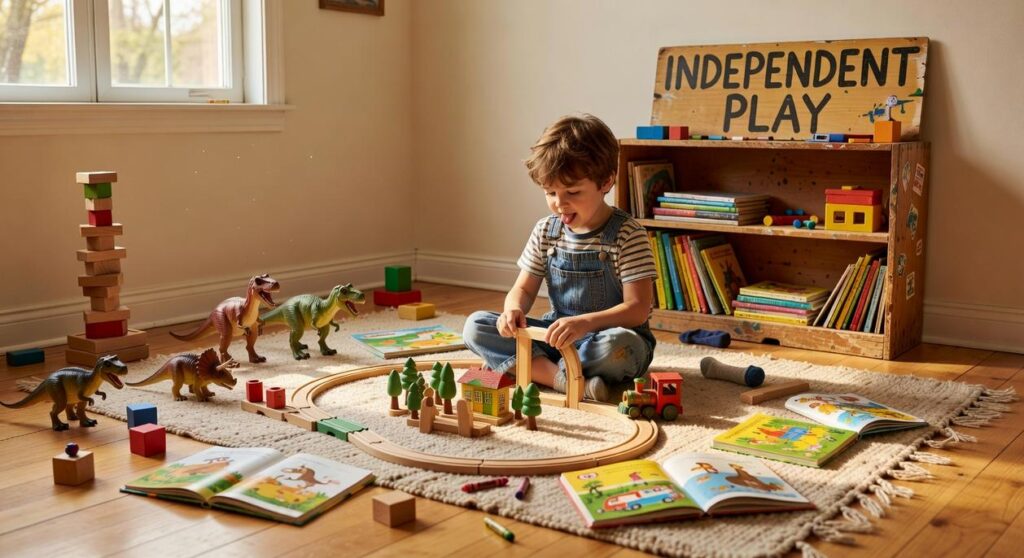
Creating a home that naturally supports encouraging independent play doesn’t require a Pinterest-perfect makeover (thank goodness). It starts with intention.
The “Yes” Space
A “Yes” space is a child-safe area where everything within reach is fair game. That means no constant “don’t touch that.”
How to set it up:
- Anchor furniture to walls
- Use low, open shelves
- Place age-appropriate toys within reach
- Remove fragile or off-limits items
Real-world example: A small rug, two baskets of toys, and a child-sized table in the corner of your living room can work beautifully. When kids don’t hear “no” every five minutes, they relax—and creativity follows.
Open-Ended Materials
Open-ended materials are items that can be used in multiple ways. A cardboard box can become a spaceship, a bakery, or a secret hideout (all before lunch).
Must-haves:
- Wooden blocks
- Cardboard boxes
- Crayons and plain paper
- Play scarves
- Natural items like sticks or stones
Research from the American Academy of Pediatrics shows simple toys foster stronger imaginative skills than electronic ones (AAP, 2018).
The Magic of Toy Rotation
Too many toys overwhelm kids (and adults, honestly).
Step-by-step:
- Divide toys into 3–4 groups
- Put most away in a closet
- Swap every 2–3 weeks
Suddenly, “old” toys feel brand new.
Limit Distractions
Turn off background TV. Reduce clutter. A calm room invites imagination to take center stage—no batteries required.
By fostering independent play, you not only nurture your child’s creativity and self-sufficiency but also pave the way for them to take on age-appropriate chores, as outlined in our practical guide for parents – for more details, check out our Age-Appropriate Chores: A Practical Guide for Parents.
Your New Role: From Playmate to Peaceful Observer
Stepping back can feel unnatural, especially when you see the blocks wobble or the storyline stall. But THE BENEFIT is powerful: your child builds problem-solving skills, resilience, and confidence without a director in the wings (yes, even if the tower falls).
Try phrases like:
- “I’m right here if you need me.”
- “I see you’re figuring that out.”
- “What happens next?”
These keep you present without taking over. When they invite you in, ask for a role and follow their rules (even if you’re the dog who drives the bus). You’ll strengthen connection while honoring their creativity.
Praise the process: “You’re working so hard on that tower!” Effort focus fuels intrinsic motivation, which research shows supports long-term achievement.
Model your hobbies. When kids see adults enjoying reading or gardening, independence feels normal. That ripple effect makes encouraging independent play easier.
Last month, I stopped staging perfect playrooms and simply stepped back. The magic? My kids built worlds from blocks and couch cushions while I drank coffee—HOT. Fostering self-directed play means encouraging independent play, giving space and trust, not Instagram moments. This week, set out blocks and walk away. Watch them.
You came here looking for practical ways to create calmer days, happier kids, and a home rhythm that actually works. Now you have simple, realistic strategies you can start using right away—from daily routines to encouraging independent play that gives both you and your child room to grow.
The truth is, the overwhelm doesn’t come from doing too little. It comes from doing too much without the right systems in place. When you build small, consistent habits and make space for encouraging independent play, you reduce burnout, support your child’s confidence, and finally create breathing room in your day.
Here’s your next step: choose one routine to simplify this week and commit to it. Then add one small opportunity for encouraging independent play each day. Consistency—not perfection—is what changes everything.
Thousands of moms turn to us daily for trusted, practical guidance that actually works in real life. If you’re ready for calmer days and more confident parenting, explore our daily tips and start transforming your routine today.
 Parenting Content Director
Nicholas Beltaisers is the kind of writer who genuinely cannot publish something without checking it twice. Maybe three times. They came to borode motherhood journeys through years of hands-on work rather than theory, which means the things they writes about — Borode Motherhood Journeys, among other areas — are things they has actually tested, questioned, and revised opinions on more than once.
That shows in the work. Nicholas's pieces tend to go a level deeper than most. Not in a way that becomes unreadable, but in a way that makes you realize you'd been missing something important. They has a habit of finding the detail that everybody else glosses over and making it the center of the story — which sounds simple, but takes a rare combination of curiosity and patience to pull off consistently. The writing never feels rushed. It feels like someone who sat with the subject long enough to actually understand it.
Outside of specific topics, what Nicholas cares about most is whether the reader walks away with something useful. Not impressed. Not entertained. Useful. That's a harder bar to clear than it sounds, and they clears it more often than not — which is why readers tend to remember Nicholas's articles long after they've forgotten the headline.
Parenting Content Director
Nicholas Beltaisers is the kind of writer who genuinely cannot publish something without checking it twice. Maybe three times. They came to borode motherhood journeys through years of hands-on work rather than theory, which means the things they writes about — Borode Motherhood Journeys, among other areas — are things they has actually tested, questioned, and revised opinions on more than once.
That shows in the work. Nicholas's pieces tend to go a level deeper than most. Not in a way that becomes unreadable, but in a way that makes you realize you'd been missing something important. They has a habit of finding the detail that everybody else glosses over and making it the center of the story — which sounds simple, but takes a rare combination of curiosity and patience to pull off consistently. The writing never feels rushed. It feels like someone who sat with the subject long enough to actually understand it.
Outside of specific topics, what Nicholas cares about most is whether the reader walks away with something useful. Not impressed. Not entertained. Useful. That's a harder bar to clear than it sounds, and they clears it more often than not — which is why readers tend to remember Nicholas's articles long after they've forgotten the headline.